Showing posts with label feast. Show all posts

Sunday, 23 March 2014

Fantasy and the Food Chain

Thus far in the project we have only examined the food eaten by our title adventurers, and have caught a glimpse into the diversity of the eating habits of hobbits, dwarves, elves, men, and Gollum. However, there has yet been nothing said on the kind of diverse foodstuffs they have the potential to be.

Tolkien's tales of Middle Earth, while also marketed to adult readers, are above all Children's fantasy literature; a surprisingly common trope of which is the risk of being eaten. As readers, we are taught at a young age that a character we may identify with is not invincible: being a lead character does not necessarily secure a place at the top of the food chain.


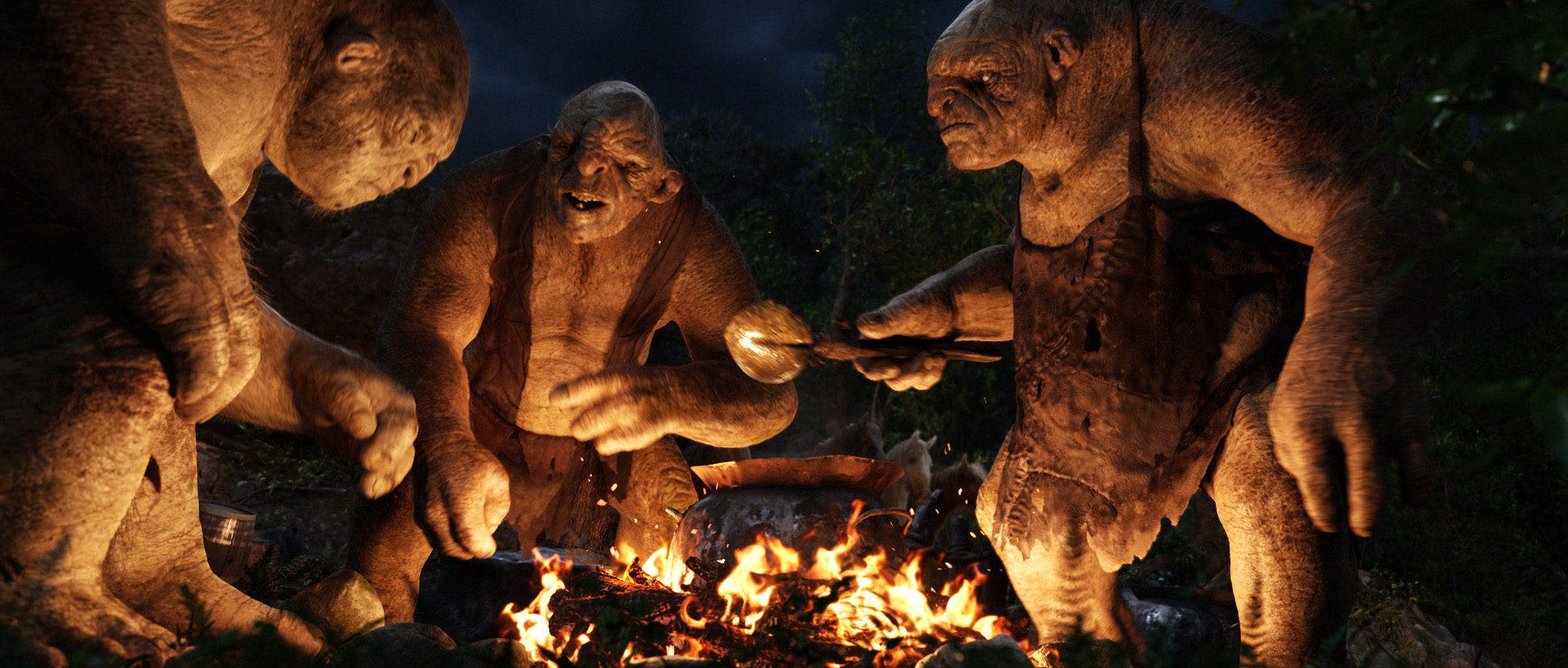
This lesson is taught very early on in The Hobbit: it is only in the second chapter, following a meat-based feast, that the party have a most unfortunate encounter with some trolls.

"A nice pickle they were all in now: all neatly tied up in sacks, with three angry trolls sitting by them, arguing whether they should roast them slowly, or mince them fine and boil them, or just sit on them one by one and squash them into jelly." (56)


Tolkien introduces the poor dwarves' torture with the understatement of the series, that the fatal problem they currently encounter is merely a 'nice pickle'. The casualness of the expression trivialises the situation, and it can be no accident that it also references a foodstuff, nevertheless a preserved foodstuff. The list of dishes seems to go in stages of turning the dwarves from complete, whole beings into more intense and unrecognisable states, further distancing them from what they are. To not only mince them, but mince them 'finely' is to obliterate them no longer into living beings but to restructure them. Unlike slow-roasting them whole, they are no longer even a carcass but simply unrecognisable shreds of meat, unidentifiable from each other. The worst fate of all is being squashed into jelly one by one, where they are no longer even recognisable as 'manflesh' but enter a completely different state: Tolkien creates disturbing mental imagery of a poor sad dwarf in a Mrs. Beeton-esque jelly mould ready to have for dessert with fruit.


With each potential dish the dwarves potenially become further from themselves as living flesh, and thus Tolkien provides the realisation that meat in all forms it ends up on the plate - roasted, minced, or jellied - was once a living thing. Of course, a narrow escape from becoming troll food is no guarantee of future safety: the series' protagonists both in The Hobbit and in the Rings novels face being eaten by spiders, dragons and goblins. "Food is fundamental" to the adventure tale, and slaughter is a necessary element of the fantasty epic, not only on the battlefield but in the daily struggle for sustenance (Keeling and Pollard, 2008: 4).
Bibliography:
  1. Image courtesy of Lord of the Rings wikia: http://img3.wikia.nocookie.net/__cb20130411232012/lotr/images/6/6b/Hobbler-trolls.jpg
  2. Image courtesy of Food History Jottings, originally from Eliza Acton's (1905) 'Jellies,' Modern Cookery.
  3. Kara K. Keeling & Scott T. Pollard,  (2008) 'Introduction' Critical Approaches to Food in Children's Literature New York: Routledge
  4. J. R. R. Tolkien (1937) The Hobbit (2012) London: HarperCollins

Sunday, 16 March 2014

Elvish eats: Lembas bread!

Due to popular demand (having nerdy friends) today I present a discussion and recipe for Lembas!

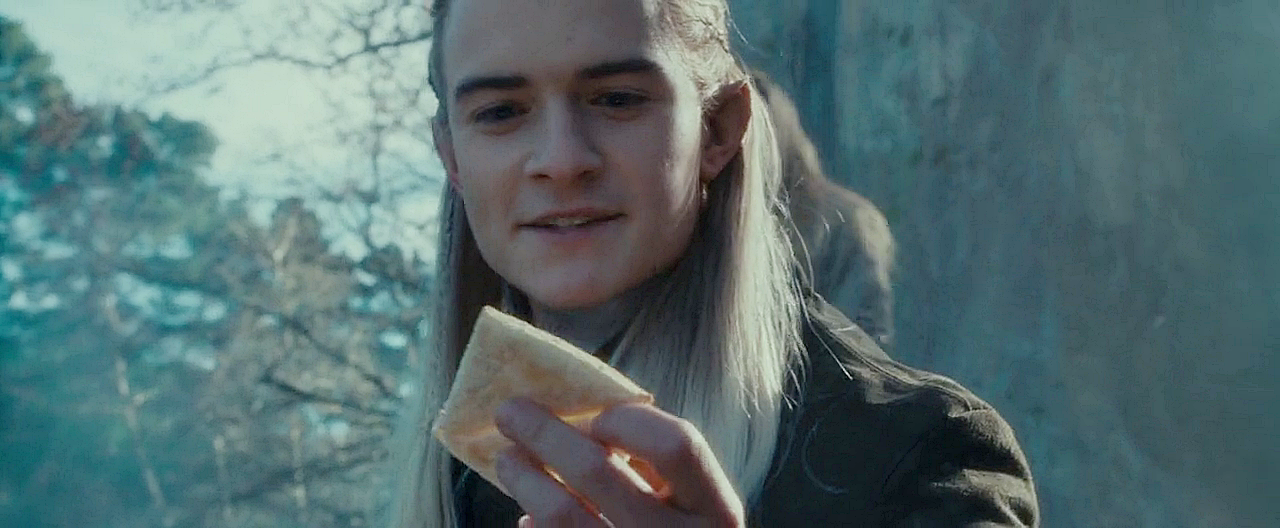
Lembas, also known as Waybread, is one of the few foodstuffs continually mentioned throughout The Hobbit and The Lord of the Rings Series, and several fans like myself take great joy in attempting to recreate it and bring a small part of Tolkien's magical world to life.


It is the ultimate travelling food - portable, lightweight, with a long shelf-life... It seems that Tolkien may have taken inspiration from military life. Lembas seem to be his fantasy interpretation of Sea Biscuits: "a type of unleavened bread which was baked, sliced and oven dried. [...] used for centuries as rations for sailors. In good conditions it would keep for a year or more in sealed barrels, but at sea it was often difficult to keep it dry, and it could become infested by weevils." (718) While it is documented by food historians that sea biscuits were one of the few long-life food products available during the time of use (16th - 19th centuries), it is also well-documented that they were bland and required softening prior to eating so as not to break one's teeth. The ingredients for Ship's Biscuits, taken from a  recipe provided by the Royal Naval Museum, are as follows:

  • Wholemeal flour
  • Salt
  • Water

While Tolkien's adventurers, not unlike the sailors of years gone by, are on a long and arduous quest, they inhabit a world of magic, and with magic come Elves. Though Peter Jackson's film adaptations refer to it as Lembas bread (which I found somewhat misleading while researching content for this post), Lembas is not far from the description of Ship's Biscuits above. The most notable exception to this of course, is that Lembas are delicious.

"The food was mostly in the form of very thin cakes, made of a meal that was baked a light brown on the outside, and inside was the colour of cream. Gimli took up one of the cakes and looked at with with a doubtful eye.
'Cram,' he said under his breath, as he broke off a crisp corner and nibbled at it, His expression quickly changed, and he ate all the rest of the cake with relish. 
[...]
'Eat a little at a time, and only at need. For these things are given to serve you when all else fails. The cakes will keep sweet for many, many days, if they are unbroken and left in their leaf-wrappings.'" (481-482)


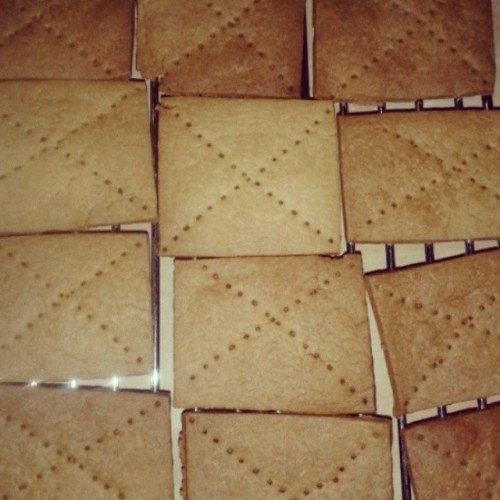
In short, Lembas are to be long lasting, filling, and sweet. This taken into account, Lembas are less like Ship's Biscuits and more like shortbread; with their high fat content, robust form and sweet flavour. The following recipe is my own.

Elvish Lembas

Ingredients:

  • 150g caster sugar
  • 300g cold salted butter*
  • 450g plain flour
  • 1tsp vanilla extract
Method:
  1. Preheat the oven to 180ºC
  2. Measure the sugar into a large mixing bowl. Chop the butter into small cubes and put in with the sugar. Cream together with a wooden spoon or electric mixer, until a pale and fluffy.
  3. Beat in the vanilla extract.
  4. Sift in 1/3 of the flour into the butter mixture and mix. When it is just combined, add the next 1/3 of flour. Repeat until all flour is added and you have a stiff dough.
  5. Shape into a ball and leave to rest in a fridge for 15 minutes.
  6. On a lightly floured surface, roll out the dough to 1cm thickness. With a knife, cut into even squares and place on a lined baking sheet. Score an 'X' across each square.
  7. Chill in the fridge for another 10 minutes.
  8. Bake for 15-20 minutes, or until a light golden brown.
Store in an airtight container (or leaf wrappings, if you have those to hand).
*If using unsalted butter, add a small pinch of salt in with the flour.


Bibliography:
  • (1999) 'Ship's Biscuit', The Oxford Companion to Food ed. Alan Davidson Oxford: Oxford University Press
  • Royal Naval Museum Library (2000) 'Ship's Biscuits: the Sailor's Diet', Research. Web: http://www.royalnavalmuseum.org/info_sheet_ship_biscuit.htm
  • J.R.R. Tolkien (1955) The Lord of the Rings: The Fellowship of the Ring. London: HarperCollins (2007)
  • Image courtesy of Lord of the Rings Wikia: http://img1.wikia.nocookie.net/__cb20121201075601/lotr/images/1/14/Lembas_bread.png

Wednesday, 12 February 2014

Feasting and Fasting (part 1).


'Feasting' as a concept has its roots, like many other aspects of secular life, in religious festivities. The  word in its present form originates from the Old French, 'feste' (now 'fête'), which we can see is also the root of 'festival'.  As we can see, feasting has close connections with festivals and celebration. Its dictionary definition, to have an abundance of food usually for a celebration is the antonym of fast, to consciously abstain from food (adapted from OED 2000).

In this post, the first of two, I will consider feasting as a celebration: "An unusually abundant and delicious meal; something delicious to feed upon; fig. an exquisite gratification, a rich treat." (OED, 2000)

The creatures of Middle Earth engage in feasts whenever possible in The Lord of the Rings: the saga begins with a feast in celebration of Bilbo Baggins' eleventy-first birthday; and closes with a feast to commemorate the life of King Théodin at his funeral. The latter is of particular interest: while the main funeral procession is one of sorrow and solemnity, the end of the burial marks the commencement of the feast, held in honour of the King's life.

When the burial was over and the weeping of women was stilled, and Théoden was left at last alone in his barrow, then folk gathered to the Golden Hall for the great feast and put away sorrow; for Théoden had lived to full years and ended in honour no less than the greatest of his sires. And when the time came that in the custom of the Mark they should drink to the memory of the kings, Éowyn Lady of Rohan came forth, golden as the sun and white as the snow, and she bore a filled cup to Éomer. (1279)


Much like the way at a Christian funeral it is customary to have a wake following the funeral, in which family members and friends discuss the life and character of the deceased over sandwiches and tea; in Rohan (land of men) food and wine is at the centre of the ritual. With plentiful food mourners are able not only able to have some physical comfort - to dissuade hunger (a physical loss) and have some pleasant tasting thing to enjoy - but emotional comfort from others as the goods upon the table are shared amongst the party. The (emotional) void left by Théodin's death is thus filled if not with joy, with peace at having one's other needs for food, comfort, and companionship. The making of a toast to past kings' memories - now including his - is a mark of closure for the mourners.

By drinking to his memory, mourners are able to not only celebrate his life but move on to happier news:

At the last when the feast drew to an end Éomer arose and said: 'Now this is the funeral feast of Théoden the King; but I will speak ere we go of tidings of joy [...]. Hear then all my guests, fair folk of many realms, such as have never been gathered in this hall! Faramir, Steward of Gondor, and Prince of Ithilien, asks that Éowyn Lady of Rohan should be his wife, and she grants it full wiling. Therefore they shall be troth plighted before you all.'
And Faramir and Éowyn stood forth and set hand in hand; and all drank to them and were glad.(1280)


Thus, the final feast of the series commemorates not only the passing of a valued life, but symbolises incoming prosperity at the union of two powerful families from Rohan and Gondor, of new beginnings for the men of Middle Earth.

Tolkein does not go into much elaboration on the type of food and drink served at this feast. As with many other instances in the novel, it is not the food that is appreciated at the ceremony as much as the company and ritual. With the entire party finally at peace, they are no longer deprived of food, rest and comfort: it is the ritual of the feast that is important.


Bibliography:

  • Oxford English Dictionaries Online (2000), feast, http://www.oed.com/view/Entry/68799?rskey=FlsEzm&result=1&isAdvanced=false#eid
  • J. R. R. Tolkien (1955) The Lord of the Rings: The Return of the King London: HarperCollins (2007)
  • Image URL: http://emilykazakh.files.wordpress.com/2012/10/eowyn-faramir.jpg