Thus far in the project we have only examined the food eaten by our title adventurers, and have caught a glimpse into the diversity of the eating habits of hobbits, dwarves, elves, men, and Gollum. However, there has yet been nothing said on the kind of diverse foodstuffs they have the potential to be.
Tolkien's tales of Middle Earth, while also marketed to adult readers, are above all Children's fantasy literature; a surprisingly common trope of which is the risk of being eaten. As readers, we are taught at a young age that a character we may identify with is not invincible: being a lead character does not necessarily secure a place at the top of the food chain.

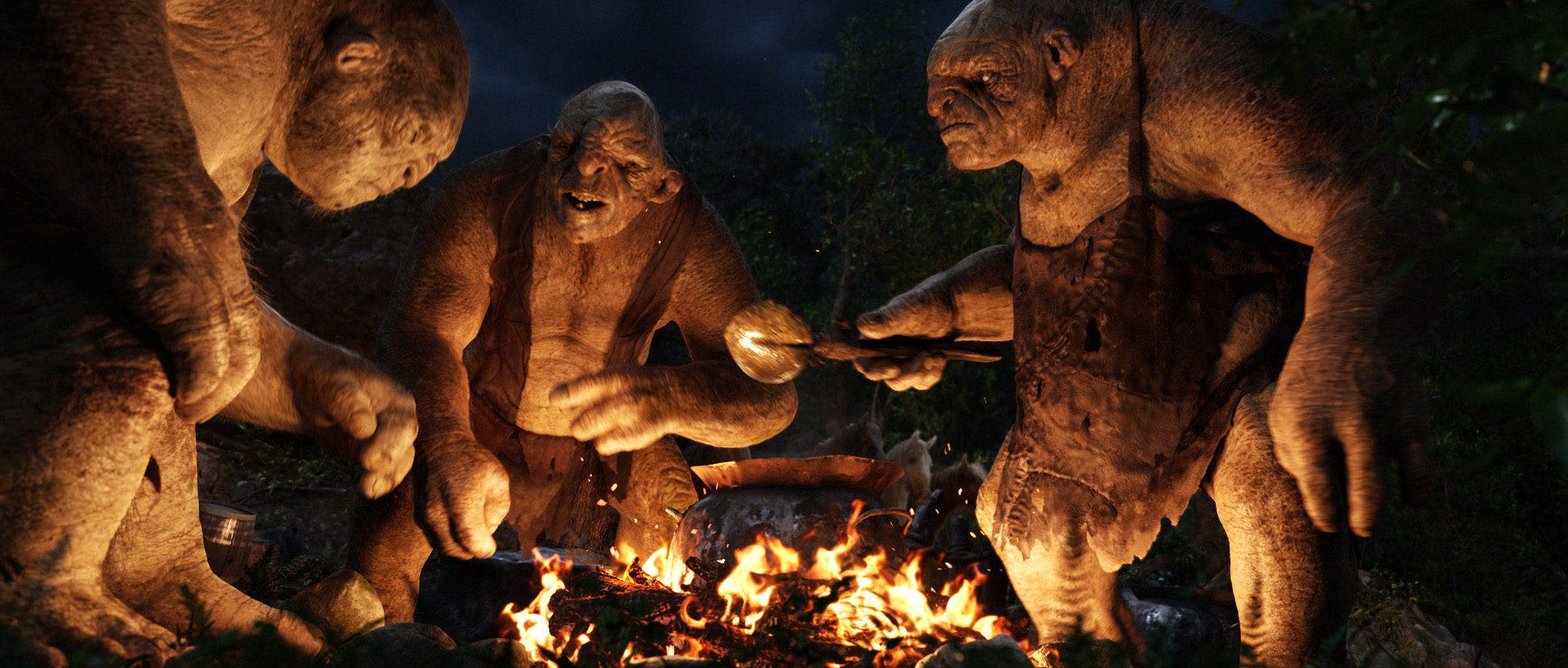
This lesson is taught very early on in The Hobbit: it is only in the second chapter, following a meat-based feast, that the party have a most unfortunate encounter with some trolls.
Tolkien introduces the poor dwarves' torture with the understatement of the series, that the fatal problem they currently encounter is merely a 'nice pickle'. The casualness of the expression trivialises the situation, and it can be no accident that it also references a foodstuff, nevertheless a preserved foodstuff. The list of dishes seems to go in stages of turning the dwarves from complete, whole beings into more intense and unrecognisable states, further distancing them from what they are. To not only mince them, but mince them 'finely' is to obliterate them no longer into living beings but to restructure them. Unlike slow-roasting them whole, they are no longer even a carcass but simply unrecognisable shreds of meat, unidentifiable from each other. The worst fate of all is being squashed into jelly one by one, where they are no longer even recognisable as 'manflesh' but enter a completely different state: Tolkien creates disturbing mental imagery of a poor sad dwarf in a Mrs. Beeton-esque jelly mould ready to have for dessert with fruit.

With each potential dish the dwarves potenially become further from themselves as living flesh, and thus Tolkien provides the realisation that meat in all forms it ends up on the plate - roasted, minced, or jellied - was once a living thing. Of course, a narrow escape from becoming troll food is no guarantee of future safety: the series' protagonists both in The Hobbit and in the Rings novels face being eaten by spiders, dragons and goblins. "Food is fundamental" to the adventure tale, and slaughter is a necessary element of the fantasty epic, not only on the battlefield but in the daily struggle for sustenance (Keeling and Pollard, 2008: 4).
Bibliography:
Tolkien's tales of Middle Earth, while also marketed to adult readers, are above all Children's fantasy literature; a surprisingly common trope of which is the risk of being eaten. As readers, we are taught at a young age that a character we may identify with is not invincible: being a lead character does not necessarily secure a place at the top of the food chain.
This lesson is taught very early on in The Hobbit: it is only in the second chapter, following a meat-based feast, that the party have a most unfortunate encounter with some trolls.
"A nice pickle they were all in now: all neatly tied up in sacks, with three angry trolls sitting by them, arguing whether they should roast them slowly, or mince them fine and boil them, or just sit on them one by one and squash them into jelly." (56)
Tolkien introduces the poor dwarves' torture with the understatement of the series, that the fatal problem they currently encounter is merely a 'nice pickle'. The casualness of the expression trivialises the situation, and it can be no accident that it also references a foodstuff, nevertheless a preserved foodstuff. The list of dishes seems to go in stages of turning the dwarves from complete, whole beings into more intense and unrecognisable states, further distancing them from what they are. To not only mince them, but mince them 'finely' is to obliterate them no longer into living beings but to restructure them. Unlike slow-roasting them whole, they are no longer even a carcass but simply unrecognisable shreds of meat, unidentifiable from each other. The worst fate of all is being squashed into jelly one by one, where they are no longer even recognisable as 'manflesh' but enter a completely different state: Tolkien creates disturbing mental imagery of a poor sad dwarf in a Mrs. Beeton-esque jelly mould ready to have for dessert with fruit.
With each potential dish the dwarves potenially become further from themselves as living flesh, and thus Tolkien provides the realisation that meat in all forms it ends up on the plate - roasted, minced, or jellied - was once a living thing. Of course, a narrow escape from becoming troll food is no guarantee of future safety: the series' protagonists both in The Hobbit and in the Rings novels face being eaten by spiders, dragons and goblins. "Food is fundamental" to the adventure tale, and slaughter is a necessary element of the fantasty epic, not only on the battlefield but in the daily struggle for sustenance (Keeling and Pollard, 2008: 4).
Bibliography:
- Image courtesy of Lord of the Rings wikia: http://img3.wikia.nocookie.net/__cb20130411232012/lotr/images/6/6b/Hobbler-trolls.jpg
- Image courtesy of Food History Jottings, originally from Eliza Acton's (1905) 'Jellies,' Modern Cookery.
- Kara K. Keeling & Scott T. Pollard, (2008) 'Introduction' Critical Approaches to Food in Children's Literature New York: Routledge
- J. R. R. Tolkien (1937) The Hobbit (2012) London: HarperCollins